Why Don't Japanese People Drink Before the Toast? — The Logic of Kanpai
Gestures & Manners · 2026-06-08 · ~1,200 words · ~4 min read
Contents (5)
- The Fifteen Seconds Nobody Explains
- Kanpai as a Threshold, Not a Toast
- What the Glasses Held Up Together Are Doing
- Not Everyone — and the Weight the Ritual Carries
- A Question I Won't Answer for You
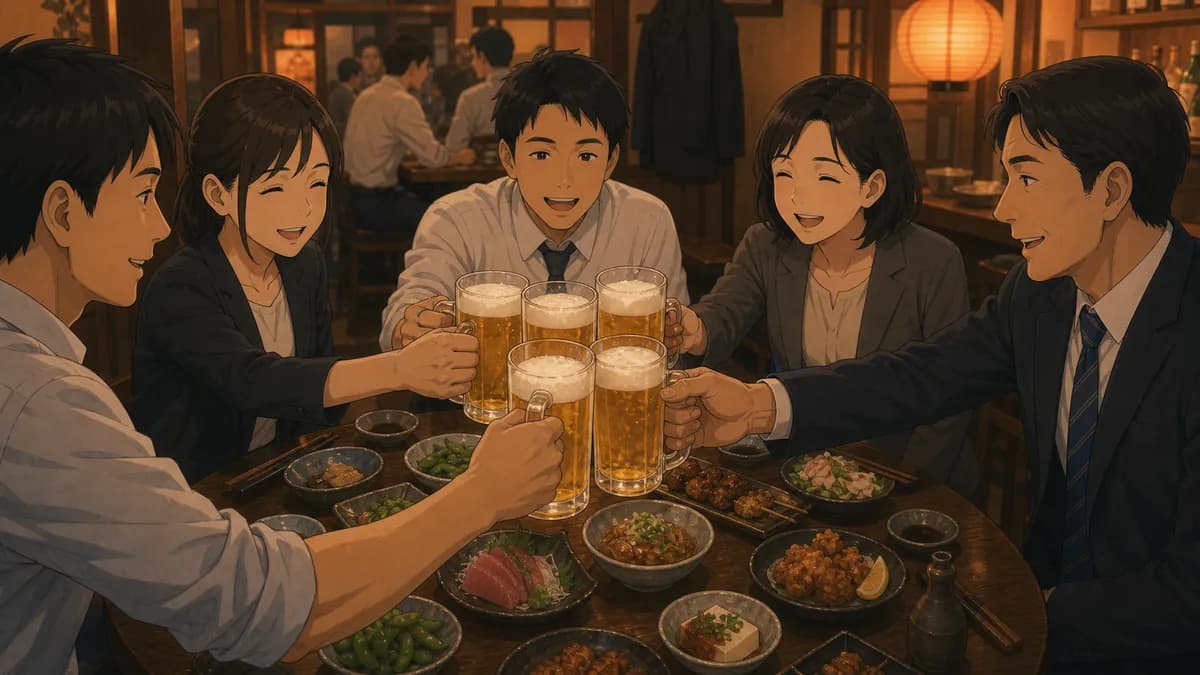
You've just arrived at an izakaya with new Japanese colleagues. The drinks land on the table, the cold beer glinting under warm light. You reach for your glass — and notice everyone has gone still, watching you. You set it down. A few seconds later, your boss says one word: Kanpai. Only then does the table come alive.
This is not an unusual story. It happens every time someone new joins a Japanese drinking occasion.
The Fifteen Seconds Nobody Explains
Kanpai happens exactly once, right at the opening of a Japanese drinking occasion. The host or most senior person at the table offers a short word, glasses go up, eyes meet briefly, and everyone drinks that first sip together.
Japan's national tourism organization describes kanpai as ensuring "nobody is left out" of the experience of starting together. (Japan Travel / JNTO, "Drinking the Japanese Way")
After that single moment, the rules loosen. People refill their own drinks or each other's. The pace becomes personal. But that first sip belongs to the group.
Even at casual gatherings between friends, many Japanese people still observe this beat — not always consciously, but as a social reflex. Reaching for your glass before others are ready reads less as a breach of etiquette and more as stepping past something everyone else was waiting for.
Kanpai as a Threshold, Not a Toast
The word itself means "empty cup" — a wish for good fortune, signaled by draining the glass. But the function of kanpai, in practice, is less about celebration and more about a collective crossing.
Here's how I see it — though others may read it differently.
In many Western traditions, a toast is often directed at someone: a person being celebrated, an occasion being marked. You raise your glass toward something.
Kanpai feels more like a threshold. From the world of work, of obligation, of separate lives, into the shared time of the table. Drinking before kanpai would mean stepping across that threshold alone, before anyone else is ready.
One way to put it: the pause before kanpai is a small act of waiting for the people around you — the same logic, perhaps, that keeps a Japanese person from walking ahead when someone in the group is still putting on their shoes.
I'm offering this as a reading, not a claim about what kanpai definitively means. There's no central text that defines this. The meaning, if there is one, runs below the surface of an action most people perform without analyzing it.
What the Glasses Held Up Together Are Doing
In formal settings with a clear hierarchy — a senior employee, a manager, a guest of honor — the glass angle carries its own grammar. Lowering your glass slightly below the other person's is a mark of respect. The moment of kanpai becomes a brief, wordless check on who is in the room and what the relationships are.
This is why kanpai is not just "let's drink" — it's a moment in which the group briefly constitutes itself before relaxing into the evening.
Not Everyone — and the Weight the Ritual Carries
Not all Japanese people treat kanpai with equal gravity. Among close friends, the ritual can be as casual as two glasses clinking the moment the drinks arrive. Younger generations, particularly in less hierarchical settings, sometimes skip the formality entirely.
And the tradition carries its own awkward weight. In a rigid nomikai — an obligatory work drinking event — kanpai can mean sitting in front of a cold beer while a senior colleague works through a long speech. Younger workers in Japan have increasingly preferred to skip such events: a 2024 survey by Recruit showed a significant portion of young employees prefer to avoid workplace drinking occasions altogether. The starting pistol of kanpai cannot make the race itself enjoyable for everyone required to run it.
Personally, I think kanpai deserves a lighter touch than it sometimes gets. If someone's running late and they've sent word — "go ahead and start" — then just start. When they arrive, you simply do kanpai again, all together. That's all. You've gathered to enjoy yourselves, so there's no need to overthink it. The pleasure of everyone beginning at the same instant is real. But the moment it hardens into a rule that binds someone, something small is lost.
A Question I Won't Answer for You
The moment when everyone goes still before kanpai is, on its surface, a small social reflex. But it points to something that shows up across many places in Japanese daily life: the group begins together, or it doesn't quite begin.
Whether that's warmth, obligation, or just habit accumulated over generations — probably all three at once — is something each person at the table is likely feeling differently.
What does the moment of starting a meal or a drink look like where you come from? Is there a signal that marks when it's okay to begin?
Sources & References
- JNTO Japan Travel, "Drinking the Japanese Way" — kanpai etiquette overview
- Recruit 2024 survey: younger worker attitudes toward workplace drinking occasions (referenced as directional finding; precise % not attributed given source access limitations)
- This article is a personal reading. The meaning attributed to kanpai is one interpretation; no single authority defines it
The Japanese Mind: Understanding Contemporary Japanese Culture
Chapters on aimai (ambiguity), amae, giri, wa and more — the values beneath the gestures and words. For readers who want to go deeper into the 'why.'
A Geek in Japan (Revised & Expanded)
A wide-angle introduction to the 'why' of Japanese culture — manga, anime, Zen, the tea ceremony and more. A natural companion to the topics Naze explores.
Share this article
Read Next
- Gestures & MannersPILLARWhat Is Omotenashi — And Why Does Japanese Hospitality Feel Different?Omotenashi is Japanese hospitality that anticipates what you need before you think to ask — and make…
- Gestures & MannersWhy Don't Japanese People Linger After Eating?Japanese diners tend to leave fairly soon after finishing, especially when it's busy. Here's the qui…
- Gestures & MannersWhy Do Japanese Restaurants Give Free Water and Oshibori?Sit down at almost any Japanese restaurant and cold water, tea, and an oshibori appear before you've…
- Gestures & MannersWhy Does Japan's School Year Start in April?Japan's school year opens in April because its fiscal year does — a calendar fixed in the Meiji era,…
- Gestures & MannersWhy Do Japanese Train Workers Point and Call? — The Science Behind Shisa KankoStation workers who point firmly at signals and call out their status aren't performing a ritual — t…
Related Articles
Articles in the same category: