Why Do People Clap at Japanese Shrines? — The Sound That Marks Arrival
Gestures & Manners · 2026-06-08 · ~1,200 words · ~4 min read
Contents (5)
- Standing at the Offertory Box
- The History — Newer Than It Looks
- What the Sound Is Actually Doing
- Not Everyone, and the Tensions in the Ritual
- Where to Feel It
You're standing in front of a Shinto shrine, watching the person ahead of you. They bow twice — deeply, waist-level. Then two crisp claps, the sound sharp and sudden in the morning air. Then another bow, hands pressed together, lips moving slightly. Then they walk away.
You step up to the offertory box. You know the bowing part. But the clapping — why the clapping?
Standing at the Offertory Box
The two claps — called kashiwade — are understood to signal the presence of the person praying, to draw the attention of the enshrined deity (kami) to the offering of prayer.
The fuller version: no single authoritative explanation exists for why this works, or what it means. The gesture is ancient. The specific form most people use today was formalized relatively recently.
The formalized sequence most visitors observe — ni-rei, ni-hakushu, ichi-rei — was codified for Shinto priests during the Meiji period (1868–1912) and gradually recommended to the broader public by the Jinja Honcho, the postwar organization that oversees most shrines. It is newer than it looks.
The History — Newer Than It Looks
On a weekend morning at a neighbourhood shrine, the line moves at the pace of prayer. Children learn the sequence at New Year's visits before they can explain it. The motion becomes reflexive — a physical grammar that the body learns separately from any theology.
At some shrines, the number differs. Izumo Taisha and Usa Jingu call for four claps rather than two. The "standard" is not universal.
Records of kashiwade reach back to Heian period nobles and samurai using hand-striking gestures to show reverence. The specific two-clap form — timed, formalized, recommended nationwide — is a product of the past 150 years or so. This doesn't make it less meaningful. But it does complicate the idea that the gesture is an ancient, unchanging window into Japanese spiritual tradition.
What the Sound Is Actually Doing
Here's how I see it — with the understanding that Shinto does not have a single governing text that defines the meaning of its gestures.
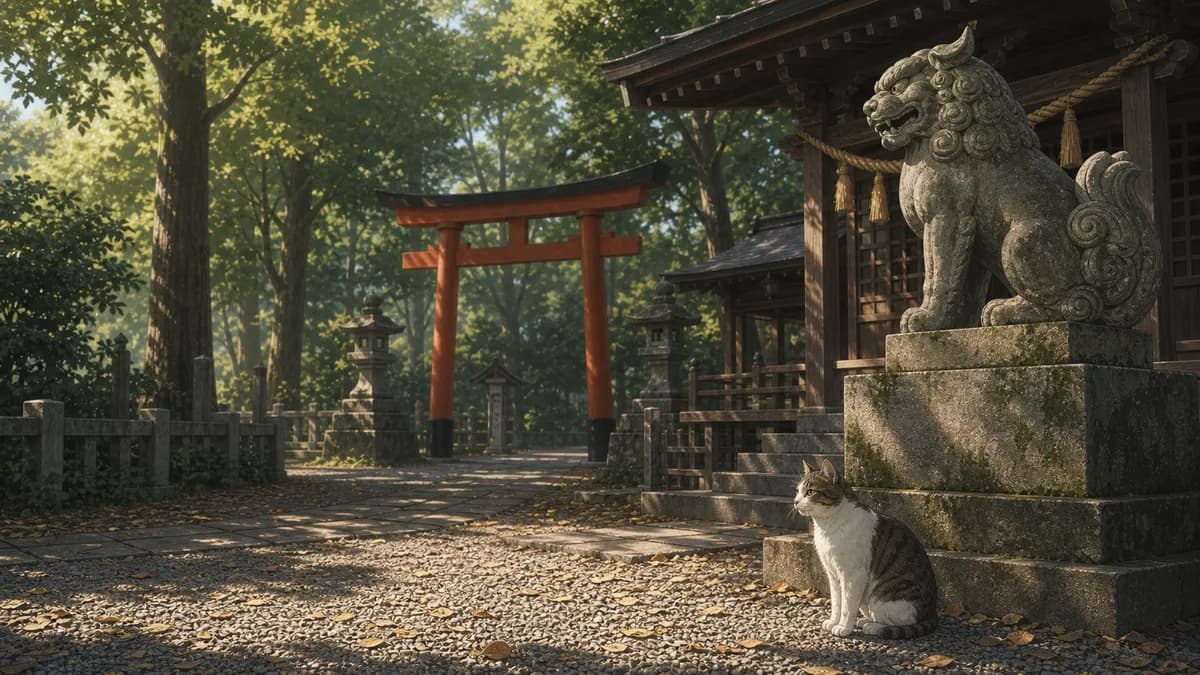
The clap is, at minimum, a sound. It punctuates. In a space where ordinary conversation is hushed, where the shift from the street to the sacred is marked by a torii gate and a gravel path and sometimes the scent of incense, the clap says: I am here. I am arriving.
One way to read it is practical: a deity whose attention you want needs to know you have arrived. Another way to read it is inward — the clap is as much a signal to yourself, a way of bringing your own attention fully into the act of prayer.
Some scholars note that the striking of hands together has appeared across cultures as a gesture of greeting, of respect, of marking a threshold. Whether the Japanese version shares these roots or evolved separately is uncertain. What is observable is the function: it creates a moment of sonic clarity in what might otherwise be a continuous stream of movement through the shrine.
I would be cautious about reading it as a window into some essential spiritual quality of Japanese people. Many visitors to shrines are tourists with no particular religious intention. Many Japanese people pray at shrines on New Year's and never think about what the clap means. The ritual persists for a range of reasons, including habit.
Not Everyone, and the Tensions in the Ritual
Not everyone follows the sequence exactly, or at all. Many visitors bow and press their hands together without any clapping — particularly at Buddhist temples, where clapping is not the practice. The Kansai Guide notes that confusing shrine and temple etiquette is common enough that signs clarifying the difference have appeared at some sites.
There is also a strand of Japanese opinion that the commercialization of shrine visits — tourism apps with step-by-step prayer guides, influencer shrine content — strips the gesture of whatever meaning it might carry. Two claps for the camera is not quite the same thing as two claps in genuine uncertainty about what you're doing and what you want.
Speaking personally, I learned this from the parent I went to the shrine with. When I put my hands together, what's in my mind is usually closer to gratitude than to a request — a vague thank-you for having made it this far in one piece. And if I do ask for something, it's less for myself than for everyone's health and the future ahead — a wish that big and that blurry. Maybe those two claps are just the way I flip a switch inside myself toward that feeling.
Where to Feel It
- To experience it: any Shinto shrine — but particularly a small neighbourhood one rather than a famous tourist destination. Fushimi Inari in Kyoto or Meiji Jingu in Tokyo are extraordinary, and the quiet of a suburban shrine on a weekday morning is a different experience entirely.
- In anime: shrines appear throughout Studio Ghibli's work — the spirit spaces in Spirited Away, the old camphor tree in My Neighbor Totoro. Neither provides a how-to guide, but both use the shrine as a threshold between ordinary life and something else.
- To read further: Nippon.com's article "Is There a 'Correct' Way to Pray at Temples and Shrines?" is the most balanced English treatment of the variation across sites.
Sources & References
- Wikipedia, "Hakushu (Shinto)" — history of the clapping gesture and Jinja Honcho codification
- Nippon.com, "Is There a 'Correct' Way to Pray?" — variation across shrine sites
- The Kansai Guide, "Don't Clap Your Hands When Praying at Temples" — temple/shrine confusion note
The Japanese Mind: Understanding Contemporary Japanese Culture
Chapters on aimai (ambiguity), amae, giri, wa and more — the values beneath the gestures and words. For readers who want to go deeper into the 'why.'
A Geek in Japan (Revised & Expanded)
A wide-angle introduction to the 'why' of Japanese culture — manga, anime, Zen, the tea ceremony and more. A natural companion to the topics Naze explores.
Share this article
Read Next
- Gestures & MannersPILLARWhat Is Omotenashi — And Why Does Japanese Hospitality Feel Different?Omotenashi is Japanese hospitality that anticipates what you need before you think to ask — and make…
- Gestures & MannersWhy Don't Japanese People Linger After Eating?Japanese diners tend to leave fairly soon after finishing, especially when it's busy. Here's the qui…
- Gestures & MannersWhy Do Japanese Restaurants Give Free Water and Oshibori?Sit down at almost any Japanese restaurant and cold water, tea, and an oshibori appear before you've…
- Gestures & MannersWhy Does Japan's School Year Start in April?Japan's school year opens in April because its fiscal year does — a calendar fixed in the Meiji era,…
- Gestures & MannersWhy Do Japanese Train Workers Point and Call? — The Science Behind Shisa KankoStation workers who point firmly at signals and call out their status aren't performing a ritual — t…
Related Articles
Articles in the same category: