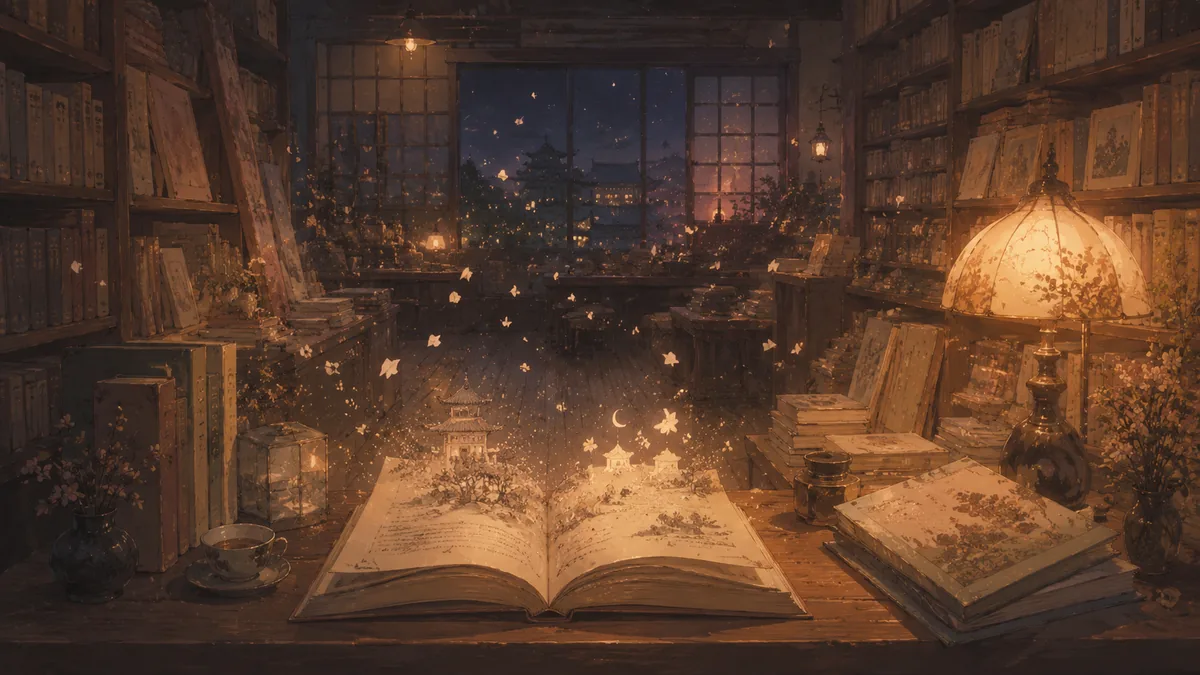
Why Does Anime Summer Feel So Bittersweet — Even If You've Never Been to Japan?
Stories & Characters · 2026-06-03 · ~1,500 words · ~5 min read
Contents (6)
- Every Symbol Already Contains Its Ending
- This Soundscape Is Real
- The Deeper Reading — Offered as One View
- Of Course, Not Everyone Feels This
- Where to Feel It More Deeply
- The Question It Leaves
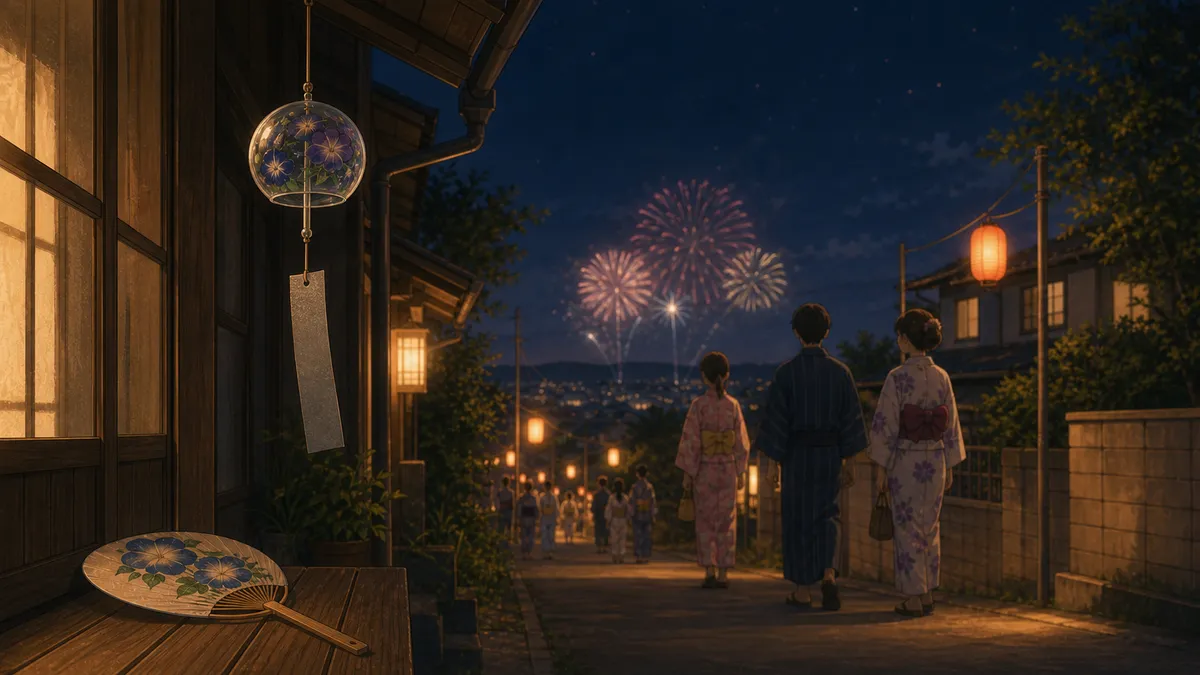
You're watching an anime. Cicadas drone somewhere just off-screen. A character sits on a wooden porch staring out at the late-afternoon sky — orange bleeding into violet. A distant public-address chime floats through the heat. Nothing dramatic happens.
And yet something in your chest tightens.
This happens reliably enough that it can't be an accident. So what's going on?
Every Symbol Already Contains Its Ending
Here's what I think is happening — though I want to hold it as a reading, not a verdict.
Anime doesn't just choose summer images at random. The images it reaches for, over and over, are ones that already contain a sense of ending. The cicada isn't simply a sound effect for "hot day." For many people who grew up in Japan, that particular cry — especially the descending, plaintive call of the higurashi (evening cicada) in late afternoon — doesn't feel like summer. It feels like summer leaving.
The evening chime isn't just a dinner bell. It's a signal that the day is closing. And in the context of summer vacation — that finite island of unstructured time — it means the whole season is one day shorter.
Put these together on a screen: cicadas, a wooden porch, someone watching a cloud, the distant chime, the smell of mosquito-coil smoke drifting in. Every single element is a signal that something is about to end. That accumulation is what creates the ache.
Anime summer feels bittersweet because every image in it already contains its own ending.
That's the core thesis of this piece. The rest is just tracing where that feeling comes from.
This Soundscape Is Real
If you've never spent a summer in Japan, it might be easy to assume anime is romanticizing or stylizing something. It really isn't — or at least, not as much as you'd think.
From late July through August, higurashi cicadas actually do start their descending cry in the late afternoon across most of rural Japan. Municipal public-address systems across the country really do broadcast chimes at 5 PM — originally a signal for children to come home, now so deeply embedded in summer-evening memory that municipal offices occasionally receive complaints when they try to cancel it.
Mosquito coils (katorisenko) really do leave that specific smell, hanging in the air on a still summer night. Fireworks festivals (hanabi taikai) — actual events, not anime invention — really do last twenty minutes and then go quiet. Obon, the Buddhist memorial season in mid-August, really is a week when the country feels briefly like it's between two worlds, before returning to normal.
Personally, when I trace my own summer memories, the first thing that comes back isn't a sound or an image — it's a smell. There really is such a thing as "the smell of summer." The smell of grass, of sun-baked ground, of the air just before the rain starts. The distant crack of thunder and its single flash of light. And the mosquito coil. Come to think of it, the summer memories lodged in my sense of smell may outnumber all the others. Alongside the soundscape, that season has a smellscape, just as vivid.
Anime creators grew up inside this soundscape. What ends up on screen isn't constructed atmosphere; it's memory pressure-tested into image. If you first encountered the higurashi cry in an anime and then heard it for the first time in real life, the feeling you got from the anime was real — it just came from someone else's summer before it became yours.
The Deeper Reading — Offered as One View
I won't say the reason is something as tidy as "Japanese culture has a special relationship with impermanence." That explanation is technically true and practically useless — every culture has elegies. And making it sound like a cultural superpower flattens the thing you're actually curious about.
Here's how I personally see it, for whatever it's worth.
Japanese summer is unusually bounded. It has hard edges. School summer vacation has a first day and a last day. Obon has a beginning and a closing rite where lanterns are floated out onto water and the ancestors' spirits are sent back. Fireworks end in smoke. The cicadas go silent seemingly overnight, and when they do, it's already autumn.
Most seasons don't announce their departure that clearly. Summer in Japan does. And perhaps — this is just a guess — when you grow up in a season that keeps reminding you it's leaving, you start to feel the beauty and the goodbye at the same time, as one thing rather than two.
The creators drawing those frames may not have decided: "I'll make this bittersweet." They may simply have drawn summer the way it lives in them. And summer, as they lived it, was already a little sad.
Of Course, Not Everyone Feels This
It would be dishonest not to say this plainly: many people in Japan experience summer as pure fun — festivals, the beach, cold kakigori shaved ice, staying up too late. The weight I'm describing isn't universal. Plenty of people hit August and feel only relief that it's still going.
And there's a shadow here worth naming honestly. The "beautiful bittersweet summer" of anime is also, in part, a kind of nostalgia product — a curated image of a season that may have been messier and harder in reality. For some viewers, the anime summer is the summer they actually remember. For others, it's the summer they half-wish they'd had. Both responses are real, and neither is wrong. But it's worth knowing the difference.
The ache you feel watching those scenes is genuine. What it's attached to — that's something only you know.
Where to Feel It More Deeply
If you want to trace this feeling through anime itself, a few works carry it more consciously than others.
Grave of the Fireflies (Hotaru no Haka, Studio Ghibli, 1988, dir. Isao Takahata) takes the summer imagery to an almost unbearable conclusion — probably not where you want to start if you're new to this feeling, but if you want to understand where the cultural weight of summer comes from, it's irreplaceable.
Anohana: The Flower We Saw That Day (2011) uses a summer setting to hold something that can't be resolved — grief that doesn't quite finish. Quieter, and in some ways harder to shake.
Summer Wars (Mamoru Hosoda, 2009) is brighter and more celebratory, but the family gathering at its center still carries the countdown feeling — a summer that knows it will end on a specific day.
If you want to feel the real soundscape rather than the animated version: consider spending a few nights in a small Japanese town in late July or early August. Find a place where you can hear the 5 PM chime from outside. Sit somewhere the cicadas are audible. Wait for the light to go orange. When that distant chime reaches you through the heat, you'll understand why it keeps appearing in anime. It doesn't feel like a time signal. It feels like a small, gentle ending.
The Question It Leaves
I won't claim anime summer captures something uniquely Japanese that outsiders can only observe from the outside. The feeling it produces in viewers around the world suggests the opposite — that something in the image is translatable, even to people who've never heard a higurashi or smelled mosquito-coil smoke.
Maybe the reason the tightness in your chest was real is that every culture has a season that announces it's leaving — and Japan just built that announcement directly into the furniture of its summer.
Or maybe not. I genuinely don't know.
What I do know is this: those anime creators weren't inventing a mood. They were remembering a real one. The chime, the cicadas, the porch, the fading light — those are the actual tools Japanese summer uses to say goodbye.
Which leaves the question back with you: what does your summer use?
Sources & References
- Municipal public-address (防災行政無線) chime practices: publicly documented by individual municipalities across Japan; the 5 PM standard is a well-established national convention
- Grave of the Fireflies (火垂るの墓), dir. Isao Takahata, Studio Ghibli / Shinchosha, 1988
- Summer Wars, dir. Mamoru Hosoda, Madhouse, 2009
- The interpretive readings in this piece are personal observations, not citations; no external academic sources were used
A Geek in Japan (Manga, Anime, Zen & Tea)
Why anime and manga took such deep root in Japan, explained from the cultural soil up — broad context for the stories-and-characters 'why.'
The Art of Spirited Away
A large-format art book of concept sketches, background paintings and storyboards from Miyazaki's Spirited Away — the craft behind the frames.
The Art of My Neighbor Totoro
Character art, background paintings and staff commentary from My Neighbor Totoro — how that nostalgic look was actually built.
Share this article
Read Next
- Stories & CharactersPILLARWhy Do Small Details Carry So Much Weight in Japan?In Japanese anime and daily life, small things — a half-finished cup of tea, shoes lined up facing t…
- Stories & CharactersWhy Are There So Many Cats in Japanese Anime?From the Catbus to Nyanko-sensei, anime is full of cats — Japan has long placed them at the border b…
- Stories & CharactersWhy Are Anime Openings So Incredibly Well-Made?Anime OPs are 90-second emotional blueprints — here's what studios pack into each cut, and why the b…
- Stories & CharactersWhy Do Anime Characters Have Such Big Eyes?Anime eyes aren't just a style quirk — they're a visual grammar. Here's how highlights, tear lines, …
- Stories & CharactersWhy Do Mundane Moments in Anime Look So Alive?Anime lingers on steam rising from rice and shoes lined at the door — not as decoration, but as proo…
Related Articles
Articles in the same category: