Why Do Japanese People Wear Masks So Often? — Courtesy, Habit, and the Quiet Shield
Everyday Japan · 2026-06-03 · ~1,900 words · ~7 min read
Contents (7)
- The Practical Layer Is Real — and It Goes Back a Long Way
- More Than Pollen: A Different Kind of Comfort
- The Courtesy and the Shield
- Tatemae: The Face You Build for the Room
- The Shadow Is Real Too
- What You'll Notice, If You Visit
- The Question I'm Left With
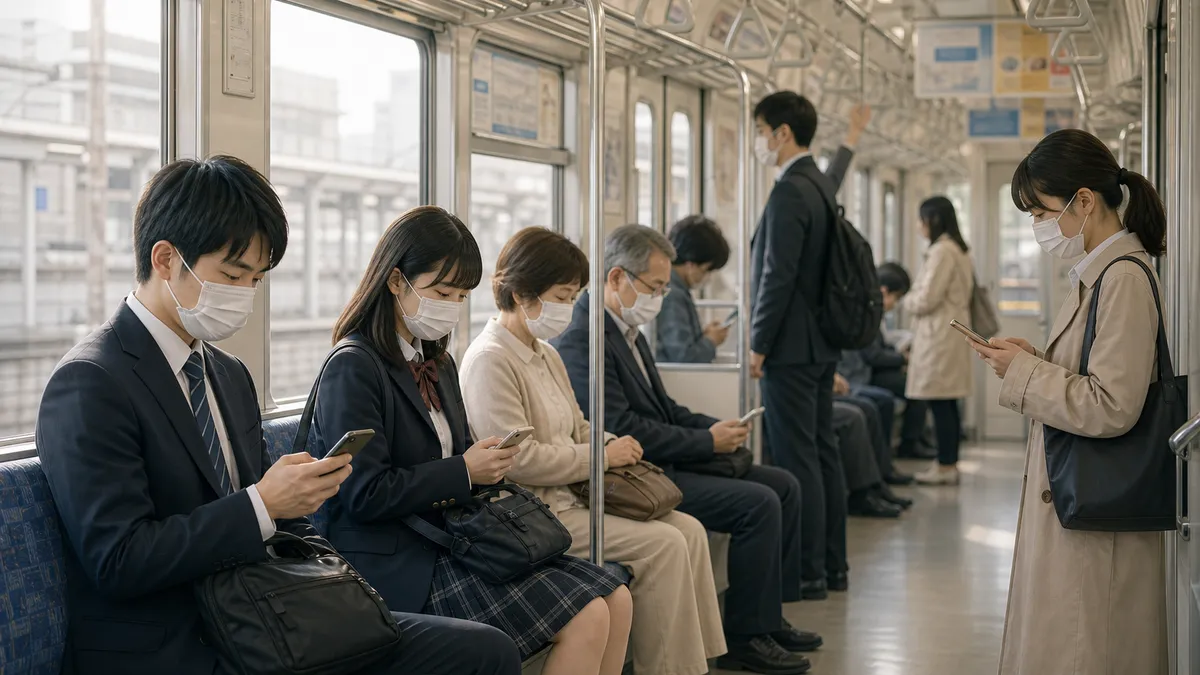
Walk through almost any Japanese train station on an ordinary weekday morning and you'll notice something that takes a moment to process: a significant number of the people around you are wearing masks. Not just in winter. Not just during a pandemic. On a clear autumn Tuesday, on a sunny spring afternoon, sometimes in the middle of summer — masks are simply part of the visual texture of Japanese public life in a way that surprises many visitors.
If you've arrived from most Western countries, it can feel genuinely odd at first. Or, if you've spent a lot of time watching anime set in contemporary Japan, maybe it doesn't surprise you at all — masked characters appear often enough that it starts to feel normal before you've ever set foot here.
So what's actually behind it?
The Practical Layer Is Real — and It Goes Back a Long Way
The first thing worth saying plainly: Japan's mask culture is not a COVID invention. It was already well underway by the 2000s, and by the 2010s it had become thoroughly ordinary.
One major driver is hay fever season. Japan's postwar reforestation program planted vast quantities of cedar (sugi) and cypress (hinoki) trees across the country, and those trees now release enormous quantities of pollen each spring. Pollen allergy affects a large share of the population; the figure depends on definition and survey year, but recent nationwide estimates have been around 40 percent or more — the Ministry of the Environment's hay-fever health manual (2022 edition) cites a 2019 national survey putting overall pollinosis above 40 percent. Every year, in many regions, with the timing varying by region and pollen type, that statistic turns itself into a masked commuter. If you visit Japan in spring and suddenly feel the urge to sneeze constantly, you'll understand the impulse quickly.
Beyond pollen, there's a long-standing norm around illness. In Japan, getting on a packed commuter train while coughing without covering your mouth has been considered mildly inconsiderate for decades — a small breach of collective etiquette. Wearing a mask when you feel even slightly unwell is simply what you do. It sits in the same register as being quiet on the Shinkansen or stepping to the side on an escalator: one of many small habits of not imposing yourself on others.
For a large share of the year, and a large portion of the population, masks have a clear and practical purpose. That much is easy to observe.
But that still doesn't fully explain the masks on a dry September Tuesday, or the ones that stayed on long after COVID restrictions lifted, or the ones worn by people who are clearly not sneezing.
More Than Pollen: A Different Kind of Comfort
Here's where I want to be careful about over-explaining — because I think this part is genuinely layered, and I'm not sure any single answer covers it.
Personal accounts shared online, social commentary in Japanese media, and informal discussions (hard data here is limited, and I won't invent numbers) suggest that many mask-wearers in Japan describe the mask as doing something beyond filtering air. Some say they feel less anxious when their expression isn't visible to others. Some describe it as not having to "perform" on the commute — being able to look tired without anyone registering it, feeling slightly anonymous in a crowd of strangers.
Japan's public spaces carry a particular kind of social density. Rush-hour trains. Open-plan offices. Neighborhood streets where you share a small radius with the same faces every morning. In those environments, managing what your face communicates — even unconsciously, even involuntarily — requires a low-level ongoing energy. A mask quietly reduces some of that demand.
One way to see it: wearing a mask in public is like drawing a small curtain. You're still there, still present, but with a slightly reduced social surface area.
I won't say that's the reason — I doubt there is one neat reason. But it's a reading that fits what I've observed, and it feels worth naming honestly.
To add my own observation: watching the people around me, I suspect part of why women put on a mask for a quick errand is simply that doing full makeup for a short trip out is a hassle. The "curtain you don't have to show" hides not just a tired expression but a bare face too. And one more thing, about the direction of the courtesy: in my own sense of it, the mask is worn far more often to avoid infecting others when I have a cold than out of worry about catching something myself. What it's protecting is less me than the person next to me.
The Courtesy and the Shield
If there's a single thread running through all of this, it might be this: in Japan, a mask tends to work in two directions at once.
Outward: I won't give you what I might have. Inward: I don't have to show you everything right now.
The outward direction fits a broader pattern of collective consideration that runs through Japanese public life. The reflex to cover a cough, the near-universal silence on the Shinkansen, the habit of queuing without complaint — these are all small acts of not imposing yourself on others. Wearing a mask when you're unwell belongs to exactly that register, and it's genuine.
The inward direction is harder to pin down, and I think it means quite different things to different people. For some, it may involve genuine social anxiety. For others, it's probably nothing more than accumulated habit from years of flu seasons and high pollen counts. And for many, perhaps, the mask has simply become part of the background texture of daily life — as unremarkable as carrying an umbrella.
There are many views on this. I'd be cautious of any single explanation, including the one I just offered.
Tatemae: The Face You Build for the Room
I want to push the inward reading one step further, because I think there's an older piece of Japanese social vocabulary that quietly explains why "not showing your face" can feel like relief rather than avoidance.
Japanese social theory talks a lot about honne (本音) and tatemae (建前) — honne being a person's private, unfiltered feelings, and tatemae being the face a person presents to fit a given social setting. It's not usually framed as dishonesty; it's closer to social maintenance, a way of not disrupting the room. A meeting face, a neighbor face, a first-meeting face — all of them adjusted, sometimes subtly, sometimes a lot, to what the situation calls for. This isn't unique to Japan in principle, but the vocabulary for naming it, and the degree to which it's openly discussed as a normal feature of social life, is distinctly Japanese.
Here's the reading I keep coming back to: a mask may physically do some of the work tatemae normally requires. If the lower half of your face isn't visible, you don't need to manage a polite half-smile on a crowded train, or arrange your expression into something socially appropriate when you're actually exhausted. The mask quietly absorbs some of the cost of maintaining an acceptable public face. Seen that way, the relief some people describe when masking isn't really about hiding — it's about being let off the hook from a specific, ongoing kind of social labor that already existed before the mask, and that the mask happens to make lighter.
I want to be clear this is my own interpretation, not an established finding — nobody puts on a mask consciously thinking about honne and tatemae. But the two things — a decades-old vocabulary for the gap between inner feeling and outward face, and a garment that literally covers part of the face — sit close enough together that I don't think the resonance is accidental.
The Shadow Is Real Too
It would be incomplete to stop there.
There have been genuine debates in Japan — more openly since COVID — about whether the persistence of mask-wearing comes at a cost. When the bottom half of someone's face is consistently hidden, it becomes harder to catch a smile, harder to read the mood in a room, harder to feel fully seen in a conversation. Some Japanese people, particularly younger ones, have talked openly about the relief of unmasking — a feeling that something had been slowly flattening in daily interaction, and that taking the mask off was a small loosening.
The mask that functions as a courtesy and a quiet shield can also function, over time, as a wall. That isn't a contradiction — it's just both things being true at the same time. The ease of not building a tatemae face and the loneliness of not being seen at all may be the same mask, viewed from two sides.
Neither wearing it nor taking it off is the obviously correct answer. Both involve something given up and something gained. It isn't only a warm habit — for some it has quietly become a source of distance. Both are real.
What You'll Notice, If You Visit
If you're traveling to Japan, the morning commute is probably the most concentrated place to observe this — a largely quiet, largely masked crowd moving through the station with practiced efficiency. It can feel impersonal at first. Depending on your mood, it might also feel like a collective agreement not to intrude.
In spring, masks move from common to near-universal in many regions, with the exact timing varying by region and pollen type. If you're sensitive to pollen at all, it's worth packing a few.
Anime fans will recognize the masked character who isn't sick — the quiet one keeping some distance, not from hostility but from something private. That image works because it maps onto something real in everyday Japanese public life.
And if you're studying Japanese, conversations through masks shift the texture of interaction in subtle ways: more weight falls on the eyes, more on tone of voice, slightly less reliance on the full range of facial expression. It's a different kind of attentiveness — not better or worse, just different.
The Question I'm Left With
COVID didn't create Japan's mask culture, but it did something to it — it widened the door, so that a broader range of people now wears one for a broader range of reasons. The habit that had long existed for pollen and colds absorbed something new: the idea that masking is simply part of how you move through shared public space.
Whether that shift becomes permanent, gradually fades, or quietly becomes something else entirely — I genuinely don't know. The habit keeps outlasting its individual explanations.
Here's what I'd leave you with: when you put on a mask yourself, or watch someone speak to you from behind one, does something shift in how the interaction feels? I'm curious how it reads from the outside.
Sources & References
- Ministry of the Environment, Japan — Hay Fever Environmental Health Manual (花粉症環境保健マニュアル, env.go.jp): pollen allergy prevalence and seasonal data
- NHK Web and Asahi Shimbun digital — coverage of post-COVID mask norms and public surveys (2022–2025)
- Honne and tatemae are widely discussed concepts in Japanese sociology and social-relations writing; the connection drawn here to mask-wearing is a personal reading, not an established finding.
- A personal reading from everyday observation; no proprietary data cited.
A Geek in Japan (Revised & Expanded)
A wide-angle introduction to the 'why' of Japanese culture — manga, anime, Zen, the tea ceremony and more. A natural companion to the topics Naze explores.
The Japanese Mind: Understanding Contemporary Japanese Culture
Chapters on aimai (ambiguity), amae, giri, wa and more — the values beneath the gestures and words. For readers who want to go deeper into the 'why.'
Share this article
Read Next
- Everyday JapanWhy Are Japanese Train Bento (Ekiben) So Special?Ekiben turn the train journey into a curated regional food tour. Here's the quiet logic behind Japan…
- Everyday JapanWhy Are There So Many Signs and Notices in Japan?Japan's streets and stations are layered with notices. Here's what the density reveals about preempt…
- Everyday JapanWhy Do Japanese People Care So Much About Seken?Seken — Japan's unnamed collective gaze — shapes everything from garbage etiquette to career choices…
- Everyday JapanWhy Do Japanese Households Still Keep a Handwritten Kakeibo? — The 1904 Method Behind the NotebookKakeibo — Japan's household account book — traces back to 1904, when journalist Hani Motoko proposed…
- Everyday JapanWhy Are Japanese 100-Yen Shops So Surprisingly Good? — The Daiso Model ExplainedJapan's 100-yen shops aren't just cheap stores — they run a specific model built on massive order vo…
Related Articles
Articles in the same category: