
Why Are There So Many Clear Plastic Umbrellas in Japan?
Everyday Life · 2026-06-08 · ~1,450 words · ~5 min read
Contents (5)
- The Rain Infrastructure
- Why Clear, Why Cheap
- The Umbrellas That Don't Come Home
- The Cost of the Convenience
- A Note on the Sea of Clear Umbrellas
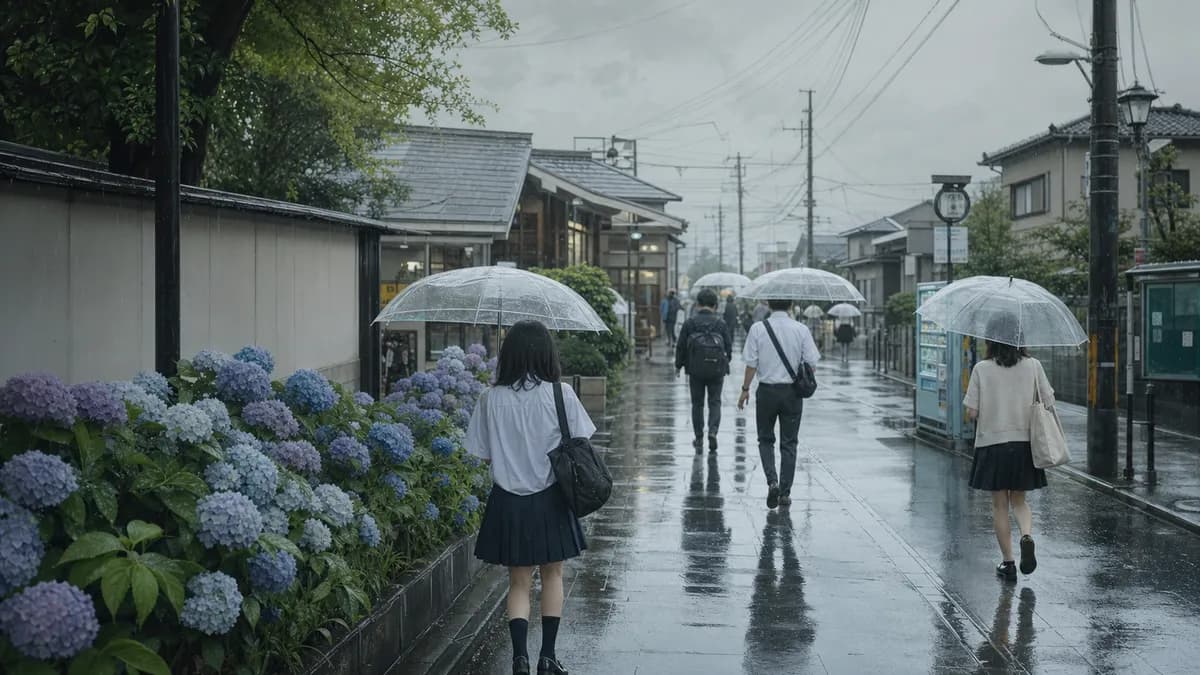
It's raining in Tokyo. Look around any train station exit and you'll see it: a dense crowd of identical transparent umbrellas, moving through the gray light in clusters.
They came from somewhere specific. They'll end the day somewhere specific too.
The Rain Infrastructure
The vinyl umbrella's prevalence in Japan is a product of infrastructure meeting habit.
Japan has one of the world's densest convenience store networks — in urban areas, it's rare to be more than a few minutes' walk from one. Those stores consistently stock a simple vinyl umbrella for around 500–700 yen (roughly $3–5 USD). When rain starts unexpectedly and you didn't bring an umbrella, the nearest konbini will have one before you've gotten significantly wet.
This on-the-spot purchase infrastructure is unusual. It makes a specific kind of behavior rational: don't carry an umbrella in advance; buy one when needed. The result is a city full of people who respond to rain the same way, producing the distinctive visual of thousands of identical clear umbrellas appearing simultaneously.
Why Clear, Why Cheap
For as long as I can remember, I assumed the canopy was clear so that you can see ahead while holding it — so you don't walk into people. Nobody taught me that; it's just what I believed, walking through rainy crowds and watching the street through the vinyl. When I finally looked into it, that instinct turned out to be roughly right.
The transparency of the vinyl umbrella isn't an accident. In crowded urban spaces — packed station exits, narrow sidewalks, queue lines — an opaque umbrella reduces your peripheral vision and makes it harder to see people at umbrella height. The clear canopy maintains sightlines, which matters when you're maneuvering through a crowd at close quarters.
Transparency also sidesteps the matching problem. A colored or patterned umbrella may not work with every outfit or context. Clear works everywhere.
The price is a function of materials (PVC canopy, lightweight frame) and volume production. The design prioritizes portability and cost over durability — vinyl umbrellas don't typically handle strong winds well. They're not designed for indefinite reuse; they're designed for weather events.
The Umbrellas That Don't Come Home
Here's what happens to many of them: they end up in umbrella stands at restaurants, shops, and offices, and they don't get collected.
When every umbrella is identical and cost only a few hundred yen, the economics of retrieval shift. Walking out of a restaurant and realizing you left your umbrella inside — was that the one you brought today, or did you pick up someone else's accidentally? Is it worth going back? The cost of replacement is low enough that for many people, the answer is no.
Japan is known for returning lost items — wallets, phones, bags left on trains come back at unusually high rates. Umbrellas are different. Their anonymity and low cost put them in a different category: things that are owned lightly, carried briefly, and released without ceremony.
The umbrella stand at the end of a rainy day, full of identical clear umbrellas without owners, is a small portrait of urban anonymity.
A count from my own genkan: there are five clear umbrellas in the stand right now. Every one of them was bought the same way — caught in the rain somewhere, no umbrella on me, nearest konbini. I never chose a single one of them, and yet they accumulate. I suspect the same census would return similar numbers from entryways all over Japan.
Speaking from experience, the vinyl umbrella is one of the very few things in Japan that actually gets stolen. Your wallet and phone stay safe, but leave a clear umbrella in the stand outside a shop and it may simply be gone when you come out. Whether that's deliberate theft or just someone grabbing the wrong one — since they're all identical — I honestly can't say. And then there's the opposite scene: handing your own umbrella, no strings attached, to a stranger who's getting soaked in a sudden downpour. The same single clear umbrella is light enough to be walked off with precisely because it's anonymous — and, for the same reason, easy to give away as a small kindness to someone you'll never see again.
And recently, the market produced an answer to the everyone's-umbrella-is-identical problem: the mejirushi charm — a small accessory that clips to the handle, whose entire job is to let you find your one umbrella in a stand full of identical ones. An ornament, working as ID. There's something quietly funny about a tool evolving in a direction nobody designed for it: the clear umbrella created a problem, and a tiny decoration from outside the umbrella stepped in to solve it.
The Cost of the Convenience
The environmental side of this is worth naming directly.
Environmental discussions in Japan have cited estimates of roughly 80 million vinyl umbrellas circulating annually, with a substantial portion discarded after limited use. The numbers vary by source and the methodology isn't uniform — but the scale of the waste is broadly acknowledged. Plastic waste from short-use consumer goods is a known environmental issue, and vinyl umbrellas are a visible example.
There's been growing discussion in Japan about more sustainable alternatives — quality folding umbrellas, rentable umbrella programs, and encouraging attachment to umbrellas as owned objects rather than disposable tools. Some cities and businesses have experimented with umbrella-sharing schemes.
But the basic infrastructure hasn't changed. As long as rain is unpredictable and convenience stores are everywhere and cheap umbrellas are stocked, the rational on-the-spot purchase will keep happening.
The clear umbrella is a product of city life working extremely well — and a small symbol of what that convenience costs.
A Note on the Sea of Clear Umbrellas
There's something particular about the visual of a Tokyo street in the rain — thousands of transparent canopies moving past each other, each person visible through the others' umbrellas, the city slightly blurred but still visible through the overlapping layers of PVC.
The clear umbrella doesn't hide who's under it. In a crowd, everyone is visible to everyone, even in the rain. There's something almost democratic about it — the same transparent mass-produced object, in every hand, keeping everyone equally dry and equally identifiable.
For a few hours, at least. Then they end up in the stand.
Sources & References
- Japanese Ministry of the Environment reports on plastic waste — vinyl umbrella disposal estimates (figures vary by publication year)
- Practical design notes on vinyl umbrella construction and visibility from general product documentation
- Lost item return rate context from National Police Agency annual statistics
The see-through plastic umbrella from this article — the one whose contents are always visible. Browse the clear umbrellas Japan is known for.
Share this article
Read Next
- Everyday LifePILLARWhy Does Japanese Daily Life Keep the Next Person in Mind?From the construction sign that apologizes for your inconvenience to the neighborhood board passed h…
- Everyday LifePILLARWhy Are Japanese Trains So Punctual?Japanese trains apologize for being one minute late. The precision isn't cultural mystique but a str…
- Everyday LifeWhy Do Japanese People Try So Hard Not to Cause Trouble? — The Logic of MeiwakuMeiwaku — causing trouble or inconvenience to others — is one of the most deeply embedded values in …
- Everyday LifeWhy Does Japan Have So Many Seasonal Limited-Edition Products?Every March, Japanese convenience stores replace their entire confectionery section with sakura-flav…
- Everyday LifeWhy Does Lost Property Get Returned in Japan? — The System Behind the StoriesTokyo saw over 4.5 billion yen in lost cash turned in to police in a recent year, with wallet return…
Related Articles
Articles in the same category: