
Why Do Japanese People Slurp Noodles? — The Sound, the Reason, and "Noodle Harassment"
Gestures & Manners · 2026-06-03 · ~1,850 words · ~7 min read
Contents (6)
- The Technique Inside the Sound
- A Culture Built Around the Bowl
- One Way to See It — and I'm Hedging Here
- The Other Side — Real and Worth Saying
- How to Actually Feel It
- The Sound at the Counter
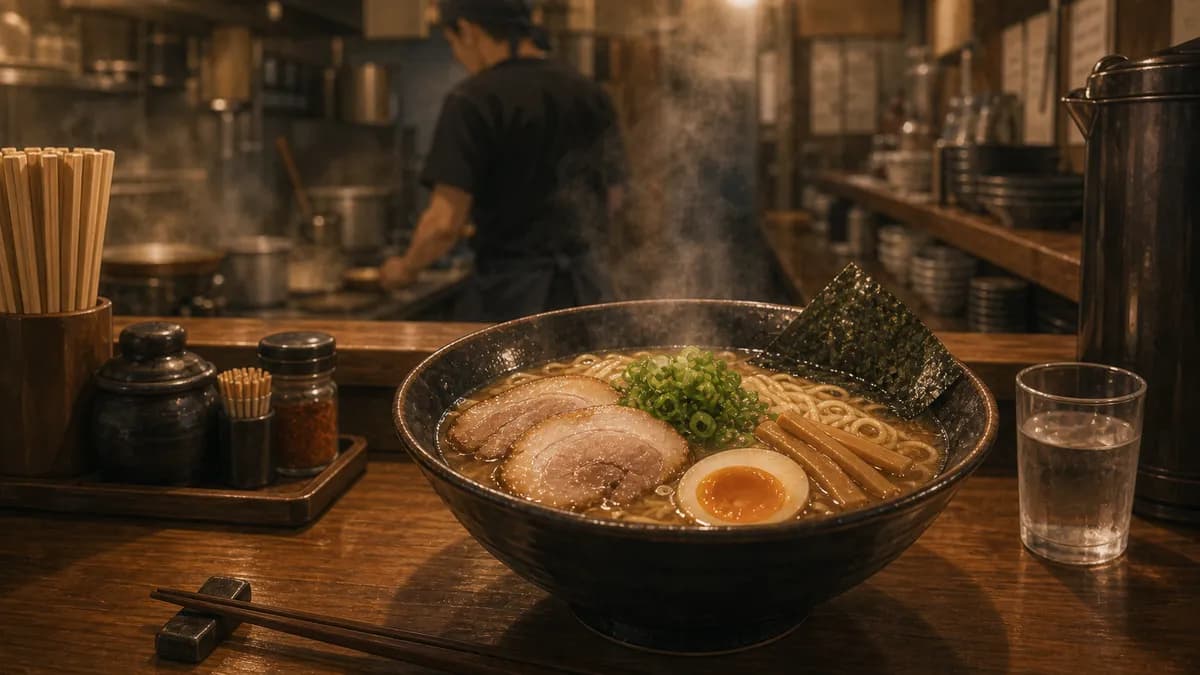
Picture a ramen counter on a cold evening. The cook sets a bowl down — pale steam rising in a tight curl over dark broth, noodles coiled just beneath the surface. The person beside you lifts their chopsticks, leans close to the bowl, and pulls the noodles toward their mouth. Then the sound: a sharp, decisive slurp. Loud. Unhurried. And nobody at the counter looks up.
If you grew up in a Western dining tradition, that sound lands in a specific way. It can feel like an accident, or a small act of carelessness — something that would earn a look at the dinner table back home. But here it was chosen. Deliberate. Normal. So — why?
The Technique Inside the Sound
Here's the core of it, at the observable level: slurping noodles is a technique, not a lapse.
When you draw noodles in with a rush of air, two things happen at once. The moving air cools the noodles slightly on the way in — genuinely useful when the bowl in front of you is close to scalding. Hot ramen is meant to be eaten hot; the fat that gives the broth its richness begins to congeal as it cools, and the flavors flatten. Getting the noodles into your mouth quickly, before they overcook in the residual heat, is part of eating the dish at its best.
But the more interesting thing is what happens to aroma. Flavor is mostly smell — a significant portion of what we experience as taste comes from our olfactory system rather than our taste buds alone, which is why food tastes flat when you have a cold. When you slurp, the rush of air carries the aerosolized broth straight to the back of your nasal passage, where the olfactory receptors sit. You're not just eating the noodle; you're inhaling the broth around it. Every slurp delivers heat, texture, and aroma simultaneously.
The sound is the technique made audible. It's a byproduct, not a statement.
A Culture Built Around the Bowl
Japan's noodle culture — ramen, soba, udon, sōmen — didn't develop in white-tablecloth dining rooms. It grew up in yatai street stalls, station-platform soba counters, and lunch-hour spots where a bowl had to be finished in ten minutes before you headed back to work. Eating quickly, eating hot, eating standing up — these were built into the DNA of noodle culture from the beginning.
Slurping fits that context exactly. It lets you eat a scalding bowl quickly without burning your mouth. It keeps the noodles from sitting too long in the broth and going soft. And it works: people who eat noodles this way are, in a practical sense, eating them better — hotter, with more aroma, at the right moment.
If you've encountered this through anime, you'll recognize the scene immediately. A protagonist bent over a bowl, steam rising, the sound effect written out in katakana on the manga page — zuru-zuru, suru-suru. That isn't an animation convention invented for effect. It's documentary. The animators drew what they saw at the counter. The lean-in, the steam, the sound: all of it comes from ordinary life. The reason anime food looks so real is partly that the eating of it looks real too.
In older Tokyo soba shops — particularly in the shitamachi neighborhoods — slurping loudly was sometimes read as a compliment, an unconscious signal that the food had earned full attention. The very quiet diner, eating politely without making a sound, might have seemed, to a regular, slightly detached from the meal. Not rude. Just... not quite there.
There's a small puzzle hiding in all this, come to think of it. Ramen the dish has been exported everywhere — there are queues outside ramen shops in London and New York. But slurping, the way of eating it, mostly didn't make the trip. The bowl and the broth crossed the ocean; the sound stayed at the port. Maybe that's the honest measure of the difference: a dish can be packed and shipped, but a way of eating lives in the body — and the body doesn't ship.
One Way to See It — and I'm Hedging Here
Here's how I see it, not as a verdict, just one reading.
There's a difference between noise and sound. Noise is what you make when you're not paying attention. Sound is what happens when you're fully in it. Slurping, in the context of a hot bowl of ramen, might belong to the second category — not a performance for the room, but an absorption in the thing in front of you.
In Japanese, the phrase teinei ni taberu (丁寧に食べる) means eating with care, with proper attention. I'm not claiming every slurp is a conscious act of culinary mindfulness. Many people slurp simply because that's how noodles are eaten, and they've never once thought about it — which is, honestly, the most grounded answer of all. But I suspect the cultural absence of shame around the sound has something to do with a long tradition where presence at the table mattered more than silence at the table.
One small linguistic clue worth noting: Japanese has onomatopoeic words specifically for eating sounds — zuru-zuru, suru-suru, bori-bori — that appear in food writing, recipe descriptions, and everyday conversation without any negative charge. The sound has a word. The word isn't rude. That's at least worth sitting with.
Of course, I could be over-reading all of this. There are many views, and I hold mine loosely.
The Other Side — Real and Worth Saying
Not everyone finds the sound neutral, including inside Japan.
As Japanese dining culture increasingly overlaps with international contexts — business dinners, hotel restaurants, open-plan offices where someone orders ramen delivery at their desk — the old slurp can create a small, quiet friction. Some younger Japanese diners actively moderate the sound in mixed company. Some find a particularly enthusiastic neighbor at the counter a bit much, even by local standards. The etiquette isn't monolithic.
This friction even picked up a name. Around the time inbound tourism surged, a coined Japanese term — nu-hara, short for "noodle harassment" — started circulating for the discomfort some people feel hearing the sound. It's worth holding the phrase loosely — and plenty of people in Japan find it overblown, for good reason. Inside Japan, slurping is a reasoned, long-established way of eating; pinning the word "harassment" on a local custom in its own home is close to a category error. You can genuinely dislike the sound — that feeling is real and allowed — but disliking something is not the same as it being a transgression.
The cleaner way to think about it isn't "is slurping rude or not." It's that manners are local. In a Japanese noodle shop, slurping is correct — it has reasons, and it's the norm. Take the exact same habit to a quiet restaurant in Paris or a family table in the US, where it isn't the norm, and it does read as rude — not because slurping is wrong, but because reading the room you're actually in is the deeper courtesy. The same act, judged by where you're standing. Slurp here; ease off there. That's not a contradiction — it's how table manners have always worked.
For my part, when I travel abroad it's "when in Rome" — I fully intend not to be rude in whatever room I'm in. But in Japan I slurp, openly and audibly. Drawing the noodles in with a mouthful of air lets the aroma of the soba lift up and out through the back of the nose, and it plainly tastes better. Come to think of it, wine does exactly the same thing. You roll it around your mouth, mix it with air, and coax the aroma out — the principle is barely different. It's just that rolling wine around the mouth isn't much of a habit in Japan, the same way slurping noodles isn't much of one in the West. Both are simply the local way of getting more of the aroma.
Though I'll admit the "when in Rome" part is easier said than done. Noodles-equals-slurping is installed in me as a default, so in a quiet restaurant abroad I have to pay real attention or the sound just slips out. It isn't that I don't know the manners; I know them, and my body still moves first. The suppressing is what takes the effort — the same way taking shoes off indoors doesn't switch off at the border. Defaults travel with you.
That cuts both ways for a visitor. The small flicker of this feels rude you might catch at a Japanese counter is your home rule talking — not a sign that anything is actually wrong. Carrying it in, even as a word like "harassment," is the one move that would actually miss the mark here. The courtesy of travel runs toward the place you're standing in: in Japan, that means letting the slurp be — and, if you like, joining in.
And for visitors who grew up with the firm rule that audible eating equals bad manners, the sound can remain genuinely jarring even after they understand the reasoning. Knowing why doesn't always override what you learned at age five. That's not a failure of logic — it's just how deeply early habits sit in the body.
The friction is real. It isn't only charming; for some people in some settings, the sound is uncomfortable, and that feeling is legitimate. Both things are true, and neither cancels the other.
How to Actually Feel It
If you want to understand slurping with your body rather than just your mind, the best approach is simple: find a ramen counter — not a tourist-polished one if you can help it, but a neighborhood spot where the cook gives you a nod when you sit down. Order a bowl. Let it arrive hot. Then try, once, to eat the way the person next to you eats.
Not to perform anything. Just to notice what happens in your mouth and nose when the air rushes in with the noodle. The aroma landing at the back of your sinuses, the heat reaching your tongue before it can cool — that sensation is what the sound is for. You'll hear it differently after that.
And if it doesn't work, let it go lightly. I once watched a visitor at a soba shop giving the slurp an honest try. The noodles were simply not cooperating — nothing was going in, and it looked like hard work. I remember feeling grateful, genuinely, that someone would take the local way of eating that seriously. And at the same time thinking: you can just eat it however it tastes good to you. Slurping isn't an entrance requirement, and nobody deducts points for a quiet eater. The sound means "this is how it tastes best" — it has never meant "this is required."
For a cinematic version: Juzo Itami's Tampopo (1985) is the most seriously intentioned film ever made about noodles, and about eating as a way of being present in the world. The ramen scenes are not comic relief. Watch how the characters lean in. Listen for the sound. The film treats slurping with a gravity it probably deserves.
If you're coming at this through food anime — Food Wars! (Shokugeki no Soma), Restaurant to Another World, or any quiet slice-of-life show where someone makes instant noodles at midnight — you'll have noticed that eating scenes almost always include sound. The steam and the implied slurp are part of the same grammar: the food is real, the heat is real, the person eating is fully there.
The Sound at the Counter
The next time you sit at a ramen counter and hear that sound beside you, you'll have a few options. You can hear it as noise. You can hear it as technique. You can still find it a bit much, and that's entirely fair.
And if you come to Japan, step into a tiny counter-only ramen shop and try it — really slurping. Not as bad manners, but as the way to take something hot while it's still hot. The pleasure of it will probably land before any explanation does.
Sources & References
- General principles of retronasal olfaction and flavor perception (standard food science literature; no single institutional source cited)
- Tampopo, dir. Juzo Itami (東宝, 1985)
- This piece draws largely on everyday observation. No single external authority is cited for the cultural dimensions discussed; they represent personal reading and general knowledge.
The Japanese Mind: Understanding Contemporary Japanese Culture
Chapters on aimai (ambiguity), amae, giri, wa and more — the values beneath the gestures and words. For readers who want to go deeper into the 'why.'
A Geek in Japan (Revised & Expanded)
A wide-angle introduction to the 'why' of Japanese culture — manga, anime, Zen, the tea ceremony and more. A natural companion to the topics Naze explores.
Share this article
Read Next
- Gestures & MannersPILLARWhat Is Omotenashi — And Why Does Japanese Hospitality Feel Different?Omotenashi is Japanese hospitality that anticipates what you need before you think to ask — and make…
- Gestures & MannersWhy Don't Japanese People Linger After Eating?Japanese diners tend to leave fairly soon after finishing, especially when it's busy. Here's the qui…
- Gestures & MannersWhy Do Japanese Restaurants Give Free Water and Oshibori?Sit down at almost any Japanese restaurant and cold water, tea, and an oshibori appear before you've…
- Gestures & MannersWhy Does Japan's School Year Start in April?Japan's school year opens in April because its fiscal year does — a calendar fixed in the Meiji era,…
- Gestures & MannersWhy Do Japanese Train Workers Point and Call? — The Science Behind Shisa KankoStation workers who point firmly at signals and call out their status aren't performing a ritual — t…
Related Articles
Articles in the same category:
- Why Bonsai Takes a Lifetime — Japan's Culture of Tending What Never Quite Finishes
- Why Do Japanese People Bow — and Does the Angle Actually Mean Something?
- Why Japanese Culture Values Ongoing Care Over Finished Products — A Different Idea of 'Done'
- Why Do Japanese People Take Off Their Shoes Indoors?