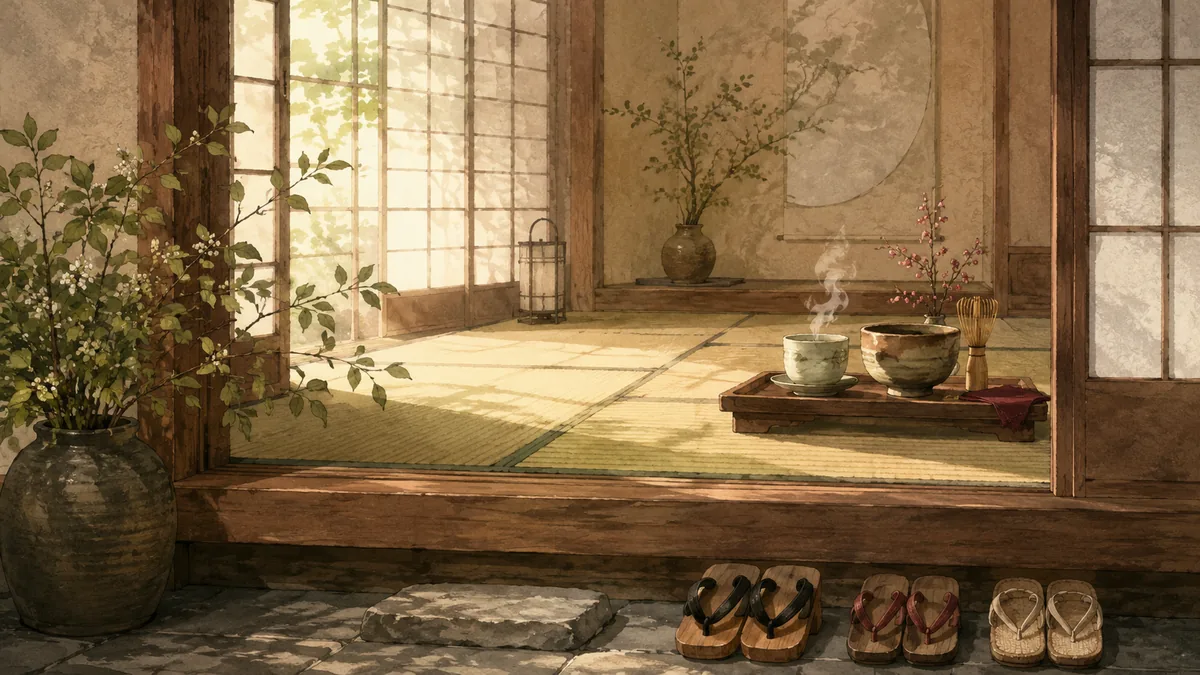
Why Japanese Temple Gardens Feel So Calming — Impermanence & the Art of Tended Nature
Gestures & Manners · 2026-06-08 · ~1,800 words
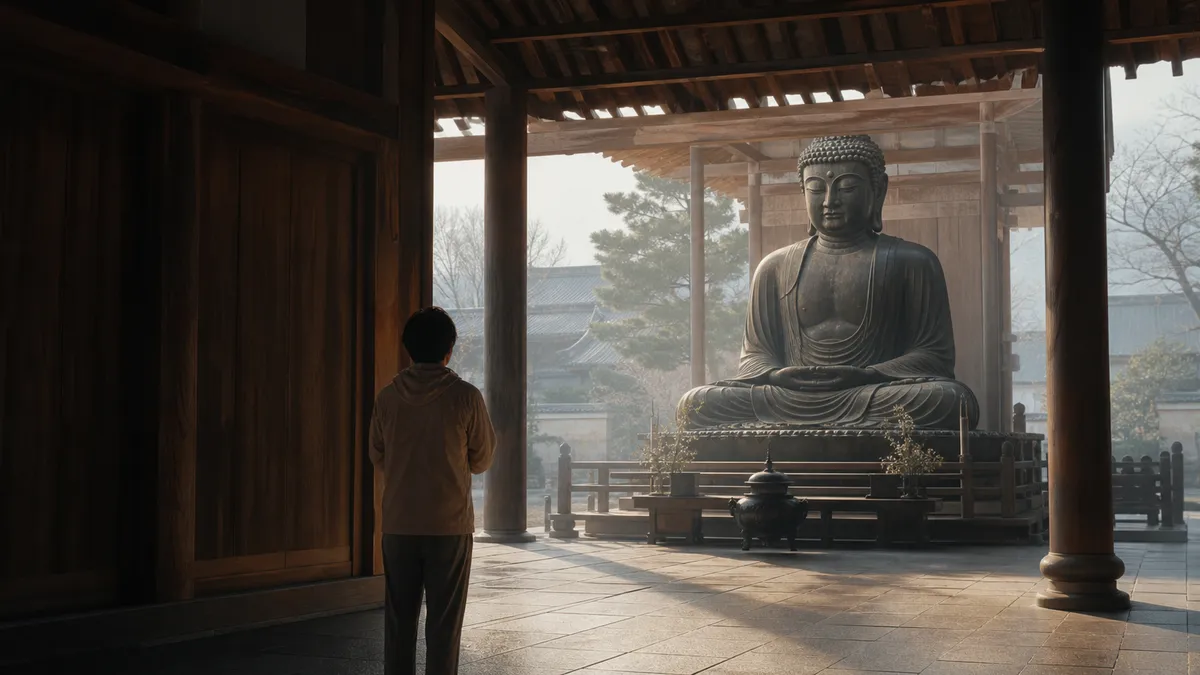
I was sitting on the wooden veranda of a small temple outside Kyoto, doing nothing in particular, when I noticed my shoulders had dropped about two inches. I hadn't made a conscious decision to relax. It just happened — somewhere between the sound of wind moving through moss and a shadow from a pine branch drifting slowly across the tatami behind me.
I couldn't explain it immediately. I still can't, fully. But I've been trying to think through why temple gardens in Japan seem to do this — not just to me, and not just to people who grew up with them.
What You're Actually Looking At — Nature That Has Been Worked
The first thing worth understanding is that a Japanese temple garden is not wild. It looks natural, sometimes extraordinarily so, but it is a very deliberate construction.
The moss you see carpeting the ground has been cultivated for years — weeds pulled by hand, moisture managed, shade calibrated. The trees have been pruned over decades, sometimes generations, to achieve that particular lean or spread. The raked gravel in a dry garden (karesansui) is reset every morning. Even the fallen leaves are curated: some are swept away, others are left deliberately, and the line between them is not random.
What you're looking at, in other words, is nature filtered through enormous sustained intention. Not wild, not sterile — something in between. A middle landscape.
This distinction matters because it changes how the space feels. Wilderness can be beautiful but also overwhelming, even anxiety-inducing. A manicured park can feel pleasant but inert. A temple garden sits at a specific point between those two registers, and I think that's part of why it hits differently.
What Makes It Feel Distinctly Japanese
If you've visited religious or contemplative spaces in other countries — European cathedrals, Balinese temples, Moroccan riads — you'll notice the Japanese temple garden does a few things that aren't universal.
The garden often upstages the building. Technically, the main hall (hondō) is the spiritual center of a Buddhist temple. But in practice, for visitors, the garden is where most of the time gets spent. The architecture frames it rather than competing with it. This is especially true in Zen-affiliated temples, where the garden is often the whole point.
The veranda structure (engawa) is built for watching. You're not meant to walk through the garden in many cases — you're meant to sit at the edge of the building and look out at it. This is a kind of enforced stillness that most Western architectural traditions don't really build in. There's no bench placed strategically for the view. You just sit on the floor.
The design assumes seasonal change. The same garden looks completely different in cherry blossom season, in the deep green of early summer, in autumn when the maples go red and orange, in winter when snow sits on the stone lanterns. A temple garden is never finished — it's a moving target. Repeat visitors aren't seeing the same thing twice, and many regulars would say that's the point.
There are transition points before you arrive. Most temples are designed with a sequence: the main gate (sanmon), the stone path, the ritual water basin (temizuya), then the garden or hall. Each threshold is a small invitation to shift your mental state before moving to the next zone. It's built-in decompression architecture.
The Idea Behind It — Impermanence and the Act of Tending
I want to be careful here, because this is where I'm offering an interpretation rather than a fact.
Running through a lot of Japanese aesthetic culture is a concept called mujō (無常) — impermanence. The idea that everything changes, nothing lasts, the same moment never comes twice. It shows up in the opening lines of The Tale of the Heike, one of Japan's most famous medieval texts: "The sound of the Gion Shōja bells echoes the impermanence of all things." The Buddhist roots are significant.
What I find interesting is the particular direction this idea tends to move in. You might expect "everything is impermanent" to produce a kind of resigned sadness, or at least passivity. But in the context of temple gardens, it seems to move somewhere else entirely: toward tending.
Because the garden changes, it needs to be tended every day. Because no arrangement lasts, each morning's raking matters. The impermanence isn't a reason to give up — it's a reason the daily maintenance is meaningful at all.
I think the calm that many people feel in front of these gardens might come from something like this attitude: an acceptance of change combined with small, continuous acts of care. Not fighting impermanence. Not surrendering to it either. Just arranging things — today — a little more beautifully than they were yesterday.
That said, this is one reading among several. Scholars point to Shinto influences, to the aesthetics of the medieval warrior class, to Chinese garden traditions absorbed and modified over centuries. No single lens captures it. I'm not a Buddhist studies scholar and I'd encourage anyone seriously interested to read more widely than this article.
How It Lives in Contemporary Japan
Temple culture isn't just historical in Japan — it's woven into the present in ways that can surprise visitors.
Temples in Japan host funerals and memorial services (hōji), which means most Japanese people have some lived experience of temple spaces connected to grief. They also appear during hatsumodē (the first shrine or temple visit of the New Year), and increasingly as destinations for what some people are calling tera-katsu (literally "temple activities") — not necessarily religious, more like what Westerners might call mindfulness retreats or wellness experiences.
Some of the better-known temple gardens in Japan pull enormous visitor numbers: Tenryū-ji and Tōfuku-ji in Kyoto, Engaku-ji in Kamakura, and many others. These are now full tourism infrastructure — timed entry, audio guides, English pamphlets, gift shops. That's not a criticism, just context.
Less visibly, most Japanese neighborhoods have small local temples that most residents walk past regularly without really thinking about. In my experience, most people don't have a deep knowledge of their nearby temple's history or doctrine. It's more like ambient familiarity — it's there, it's been there, and it does something to the texture of a neighborhood.
What Visitors Often Say
One thing I hear fairly often from people visiting Japan for the first time is something like: "I planned to spend twenty minutes at that temple and ended up staying two hours."
The building itself might not have taken long. But the garden stopped them. They found themselves sitting on the engawa without having consciously decided to sit down. Time slowed in a way they weren't expecting and couldn't quite account for.
I don't think this is unique to any particular cultural background. The tended nature / enforced stillness combination seems to do something fairly consistent across a wide range of people. What shifts is the interpretive frame — someone with a background in Buddhist practice might read the garden one way; someone with no particular context might just feel it as unexpectedly quiet.
Both seem valid to me.
A Note on Expectations — It's Not Always Peaceful
I want to be honest about something, because this article could otherwise read like a tourism pitch.
Many of Japan's most famous temple gardens are crowded. Genuinely, surprisingly crowded — especially during cherry blossom season in late March to early April, and during autumn foliage in November. Tōfuku-ji in Kyoto during peak autumn can feel less like a meditative space and more like a slow-moving queue with a beautiful backdrop. The experience of "time stopping in front of a garden" is much harder to access when you're shoulder-to-shoulder with other people all doing the same thing.
If the calm is what you're after, the practical advice is: early morning right when gates open, weekdays over weekends, or — and this is genuinely underrated — the small neighborhood temple that isn't in any guidebook, two blocks from wherever you're staying. Those places often have the thing in purer form.
Also: being Japanese doesn't mean having a deep relationship with temple gardens. Many people I've talked to in Japan are vaguely familiar with temples through family events but haven't sat quietly in a garden since childhood, if ever. It's not a lived practice for most people — it's a possibility that's available, and that some people return to at different points in their lives.
The last time you stopped in front of a garden — anywhere, in any country — and felt time slow down a little: what was it about that place? I keep thinking the answer isn't uniquely Japanese. But Japan has built a lot of infrastructure around the question.
Sources & References
- Public documentation from Tenryū-ji (Kyoto), Tōfuku-ji (Kyoto), and Engaku-ji (Kamakura), used as general reference for garden history and temple structure
- The Tale of the Heike (平家物語), various English translations, for the mujō passage
- General introductory texts on Japanese garden history and Zen aesthetics — multiple interpretations exist and no single scholarly consensus covers all claims here
- Personal observation and conversations; this article reflects one interpretation, not authoritative doctrine
The Japanese Mind: Understanding Contemporary Japanese Culture
Chapters on aimai (ambiguity), amae, giri, wa and more — the values beneath the gestures and words. For readers who want to go deeper into the 'why.'
A Geek in Japan (Revised & Expanded)
A wide-angle introduction to the 'why' of Japanese culture — manga, anime, Zen, the tea ceremony and more. A natural companion to the topics Naze explores.
Share this article
Read Next
- Gestures & MannersPILLARWhat Is Omotenashi — And Why Does Japanese Hospitality Feel Different?Omotenashi is Japanese hospitality that anticipates what you need before you think to ask — and make…
- Gestures & MannersWhy Don't Japanese People Linger After Eating?Japanese diners tend to leave fairly soon after finishing, especially when it's busy. Here's the qui…
- Gestures & MannersWhy Do Japanese Restaurants Give Free Water and Oshibori?Sit down at almost any Japanese restaurant and cold water, tea, and an oshibori appear before you've…
- Gestures & MannersWhy Does Japan's School Year Start in April?Japan's school year opens in April because its fiscal year does — a calendar fixed in the Meiji era,…
- Gestures & MannersWhy Do Japanese Train Workers Point and Call? — The Science Behind Shisa KankoStation workers who point firmly at signals and call out their status aren't performing a ritual — t…
Related Articles
Articles in the same category:
- Why Japanese Gardens Leave So Much Empty — The Aesthetics of Ma and Mitate
- Why Is Japanese Gift Wrapping So Elaborate? — The Greeting Before the Gift
- Why Bonsai Takes a Lifetime — Japan's Culture of Tending What Never Quite Finishes
- Why Do Japanese People Bow — and Does the Angle Actually Mean Something?