Why Do Japanese Cashiers Use a Money Tray Instead of Taking Cash From Your Hand?
Gestures & Manners · 2026-06-07 · ~1,300 words · ~5 min read
Contents (6)
- The Tray Has a Name
- The Practical Case — Already Enough
- The Distance That Isn't Coldness
- The Other Side of the Same Object
- At the Counter
- A Question I Won't Answer for You
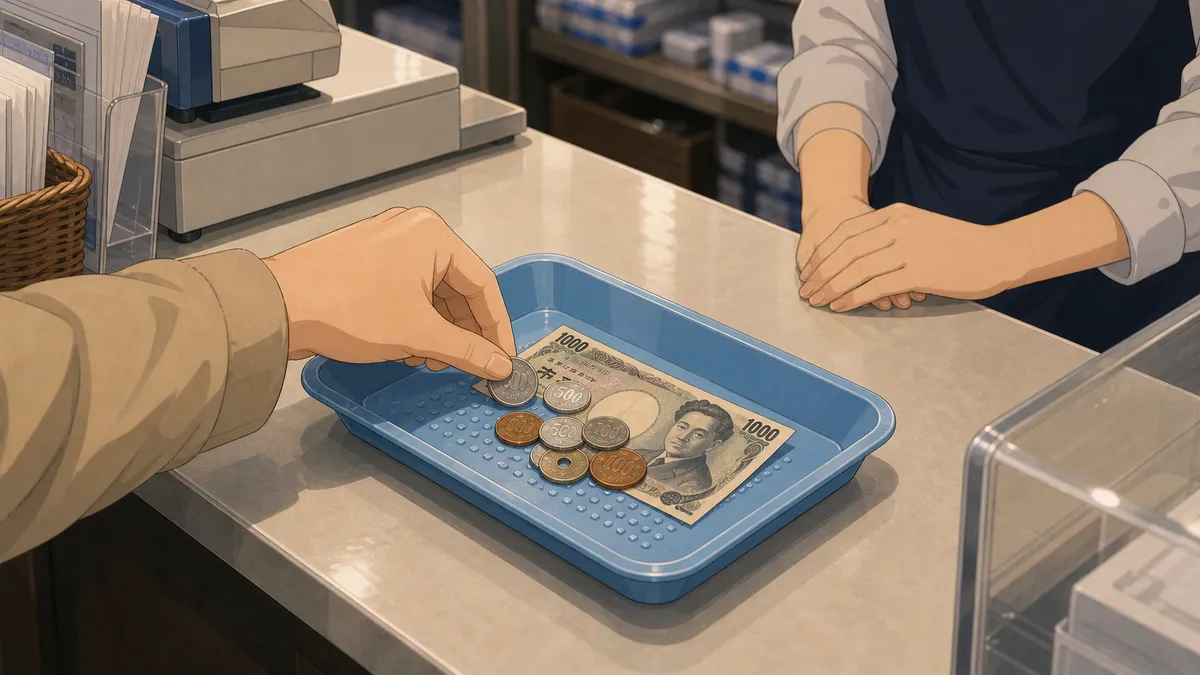
You're standing at the register of a convenience store in Japan. You hold out your coins. The cashier smiles and gestures, lightly but clearly, toward a small tray sitting on the counter. Not your hand — the tray. You place the money there. They count it there. Your change comes back arranged on the same surface. The whole exchange takes about fifteen seconds.
It's one of those small moments that catches first-time visitors off guard. Nobody warned you about the tray. And yet it's everywhere: pharmacies, ramen shops, department store registers, the neighborhood hardware shop that hasn't changed its layout in decades. Wherever cash moves in Japan, there is almost always a small tray on the counter.
The Tray Has a Name
The tray is called a カルトン — romanized as karton or, in retail contexts, sometimes written calton. The word comes from the French carton, meaning cardboard. The term appears to have entered Japanese retail usage sometime in the postwar decades, as Western merchandising practices gradually filtered into Japanese commercial life. Modern trays are rarely cardboard — most are flat rectangles with rubber or leather trim, roughly the size of a playing card wallet laid open.
The name is standard in the retail industry, but many customers have never heard it. They just know the tray is there, and they use it.
The Practical Case — Already Enough
The カルトン's first job is immediately practical. Coins placed flat on a tray are easy to count, easy to verify at a glance, and almost impossible to drop in that fumbling moment when two people's hands try to complete the same handoff simultaneously. If you've ever chased a ¥1 coin rolling across a counter while a line builds behind you, you understand exactly what the tray solves.
Japanese retail staff train specifically for this choreography. The sequence — money on the tray, counted on the tray, change returned on the tray, receipt handed separately — is practiced until it's automatic. The efficiency is real.
The tray creates a shared, neutral space where the transaction happens cleanly — no fumbling, no ambiguity, and both people can see exactly what's changing hands.
That's already a complete explanation. But there's a layer underneath that I keep returning to.
The Distance That Isn't Coldness
In many countries, taking money from someone's outstretched hand is entirely unremarkable — half a second of contact, a brief mutual acknowledgment, nothing more. In Japan, that same half-second fingertip moment with a stranger carries a slightly different texture. I wouldn't call it a taboo or a written rule. But there is a quiet awareness, I think, of the other person's physical space — even in something as routine as paying for a coffee.
Here's how I see it — and I want to be careful not to overstate this. The tray doesn't just prevent fumbling. It removes a question entirely: whose hand goes where, who pulls back first, does anyone make contact. The tray is simply there — neutral ground that belongs to neither person.
One way to read it: not handing money directly to someone's hand isn't coolness or disinterest. It might be a form of consideration — a way of not imposing even briefly on the other person's space in an interaction that, for a cashier on a full shift, happens hundreds of times a day.
I won't say that's the reason. I doubt there's one single reason for something this woven into daily practice. But that's how the カルトン reads to me.
The Other Side of the Same Object
Of course, not everyone experiences the tray this way — and it's worth being direct about this.
For visitors from cultures where a cashier taking money from your outstretched hand is a natural, warm gesture — a small confirmation that the exchange is between two humans — the tray can feel unexpectedly clinical. "Why won't they just take it from me?" The distance that reads as consideration from one angle reads as remove from another. That's not a misreading. It's a real response to a real thing.
The same small ritual can feel like care or like professional detachment, depending on what you walk in carrying. Both are honest. The tray doesn't resolve that.
For what it's worth, my own sense is that COVID was a big turning point in how the tray gets used. On top of that, younger people can be a little germ-averse — I've heard of eating potato chips with chopsticks so as not to dirty a phone — so more people may simply want to avoid hand contact altogether. So in the end, I think it really comes down to the person. Honestly, I'd rather just have my change dropped straight into my hand; it's faster, and I'm grateful for it. Then again, at a place like 7-Eleven you now pick your items on a touch panel and the payment is nearly self-service, so the whole thing is drifting toward neither tray nor hand.
And the perfected system has exactly one weak point, which I'll confess from experience: sometimes you can't pick the coins up. A flat coin on a flat rubber tray gives your fingertips nothing to grip — and by some law of the universe, this happens precisely when a line is forming behind you. Quietly fumbling with a one-yen coin while the queue grows: the design is flawless, and the final move is still left to human fingers. Those few awkward seconds are part of the calton landscape too.
At the Counter
If you want to pay attention to this in Japan, any convenience store works — but don't stop there. Watch at a small neighborhood pharmacy, where the same tray appears even when the counter barely has room for it. Watch at a standing ramen shop, where everything is calibrated for speed and the tray still shows up. The practice scales from a ¥100 snack to a ¥10,000 purchase.
You may have seen this in anime. If you look closely at register scenes, there's often a カルトン visible in the background — coins arranged on a small tray under fluorescent light, the cashier's hand hovering above rather than reaching across. That's not artistic invention. Animators draw it because it's there, the same way they draw the specific texture of a convenience store floor or the exact sound of a sliding door. Background accuracy matters to Japanese animators in a way that quietly teaches you things.
Small family shops sometimes use a tray so worn the rubber edge has cracked. Convenience store chains issue standardized ones in their own colors. The form varies. The choreography doesn't.
A Question I Won't Answer for You
The カルトン is so ordinary in Japan that most people use it their entire lives without asking why. Bring it up in conversation and there's usually a pause. "Because... that's just how you pay?"
Maybe that's the most honest answer available. The tray isn't a statement about culture or distance or any particular quality of the way people here feel about touch. It's a piece of choreography that works — and working quietly, without drawing attention to itself, is exactly what makes it good.
What does the moment of handing money feel like where you are? Is it warmth, formality, or something you've also never stopped to ask about?
Sources & References
- The term カルトン (calton): standard Japanese dictionaries list it as a borrowing from French carton; the precise decade of widespread adoption in Japanese retail is not documented in a single public record.
- Cashier training practices and register choreography: based on general knowledge of Japanese retail industry standards; no specific institution cited.
- This article is a personal reading based on everyday observation. No statistics or fabricated authorities are cited.
The Japanese Mind: Understanding Contemporary Japanese Culture
Chapters on aimai (ambiguity), amae, giri, wa and more — the values beneath the gestures and words. For readers who want to go deeper into the 'why.'
A Geek in Japan (Revised & Expanded)
A wide-angle introduction to the 'why' of Japanese culture — manga, anime, Zen, the tea ceremony and more. A natural companion to the topics Naze explores.
Share this article
Read Next
- Gestures & MannersPILLARWhat Is Omotenashi — And Why Does Japanese Hospitality Feel Different?Omotenashi is Japanese hospitality that anticipates what you need before you think to ask — and make…
- Gestures & MannersWhy Don't Japanese People Linger After Eating?Japanese diners tend to leave fairly soon after finishing, especially when it's busy. Here's the qui…
- Gestures & MannersWhy Do Japanese Restaurants Give Free Water and Oshibori?Sit down at almost any Japanese restaurant and cold water, tea, and an oshibori appear before you've…
- Gestures & MannersWhy Does Japan's School Year Start in April?Japan's school year opens in April because its fiscal year does — a calendar fixed in the Meiji era,…
- Gestures & MannersWhy Do Japanese Train Workers Point and Call? — The Science Behind Shisa KankoStation workers who point firmly at signals and call out their status aren't performing a ritual — t…
Related Articles
Articles in the same category: